ServicesReverse Osmosis
Reverse Osmosis in St. Petersburg
A reverse osmosis system sits in the cabinet under your kitchen sink and feeds a separate tap just for the water you drink and cook with. We explain what it removes, what it leaves in and what upkeep looks like, then install it neatly so you can quit buying cases of bottled water.
What reverse osmosis is, in plain terms
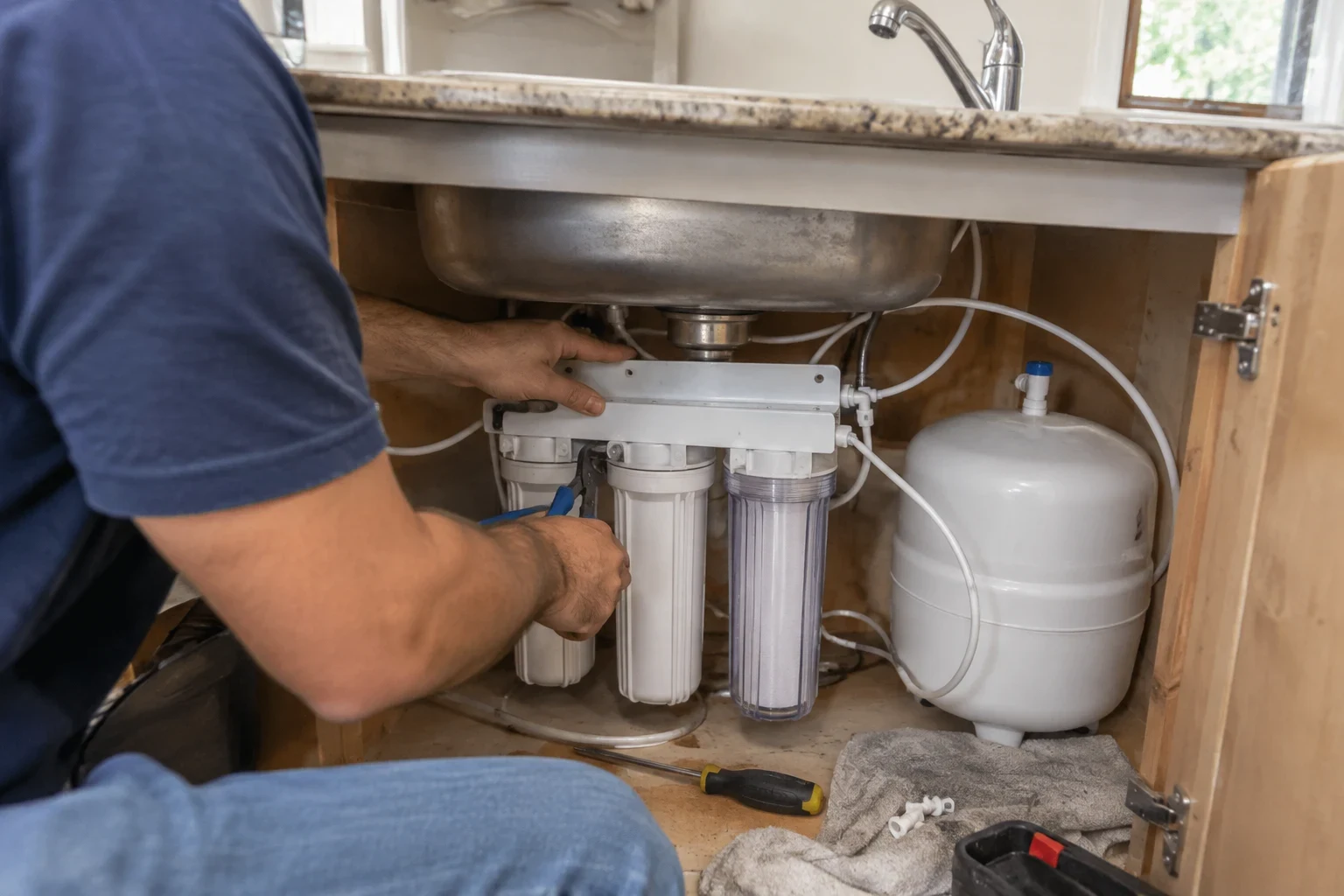
Your tap water gets pressed through a membrane with tiny pores. Water molecules pass. Most of what is dissolved in the water stays behind, including lead from aging pipes and fixtures and a long list of trace contaminants. Two prefilters ahead of the membrane trap grit and chlorine. A carbon filter after it cleans up the taste. The finished water fills a small tank and pours from a separate faucet.
This system handles drinking water only. It serves one tap, or two if we add a line to your refrigerator. For chlorine odor at the shower or white crust on fixtures around the house, whole-home filtration or a water softener does that job better, and we will point you there.
Here is the plain truth. City water already passes its standards. People choose RO for water that tastes better, clearer ice and coffee, and one less worry about what older plumbing in your home might add.
What comes with an RO install
A look under your sink first
We check the cabinet space, the drain line and the shutoff valve. Then we tell you which system fits and the reason for it.
Four filter stages
A sediment prefilter, a carbon prefilter, the membrane and a carbon post-filter. The early stages shield the membrane, which helps it last.
Its own drinking faucet
A small tap on your sink deck or countertop. If there is an open hole already, we use it. If not, we drill a clean one.
Drain and tank connections
Part of the water goes to drain while the system works. We hook that line up the right way so it stays quiet and does not back up, and place the tank where it takes the least room.
Ice maker hookup on request
Want RO water in your ice cubes and door dispenser as well? We add a tubing run from the system over to the refrigerator.
Support once it is running
You get ongoing customer support for maintenance, filter replacements, and service needs. We label which filter is which so you know what is due and when.
Signs an RO system makes sense for you
- Bottled water fills your pantry
- If everyone grabs a bottle because the tap tastes wrong, an RO faucet gives you that same water without the hauling.
- Your morning coffee tastes off
- Chlorine and dissolved solids can make coffee and tea dull or harsh. RO takes most of that out of the cup.
- The plumbing in your home is older
- Houses built before the mid-1980s may have lead solder or old brass fittings. An RO system cuts lead right at the faucet you drink from.
- Ice is cloudy and glasses spot
- Dissolved solids leave white marks on glassware and make murky cubes. RO water freezes clearer and dries cleaner.
- Your old RO drips or crawls
- A glass that takes ages to fill often just needs a new membrane or filters. If the whole unit is worn out, our water softener and filtration system replacement page covers swapping it.
What to expect on install day
- 1
A phone conversation first
Let us know what you dislike about your water and which sink you have in mind. We lay out the choices and what each means for cabinet room and upkeep.
- 2
Map out the cabinet
When we arrive, we empty the space under the sink, look at the cold line and the drain, and pick spots for the tank and filters that leave you the most storage.
- 3
Mount and hook up
We set the faucet, connect to the cold water line and the drain, then hang the filters and place the tank. A typical kitchen job runs a couple of hours.
- 4
Flush, test and tidy
Fresh filters have to be flushed before anyone drinks from them. We run the system, look at each fitting for drips, wipe out the cabinet and haul away our packaging.
- 5
Walk you through care
We show you each filter and its change schedule. Expect prefilters every 6 to 12 months and a membrane every few years.
What moves the price
Most RO installs are pretty similar, but a few things change the number. We give you a clear price on the phone or at the sink before any work starts. No surprise add-ons after the fact.
- Tank or tankless system
- Tank systems are the common choice. Tankless units fill faster and save cabinet space but cost more up front.
- Your countertop
- Drilling a faucet hole in laminate is quick. Granite and quartz take special bits and more time.
- Extras you choose
- A remineralization stage adds some minerals back for taste. A permeate pump helps when water pressure is low and cuts down on wastewater. A fridge line adds a run of tubing.
- What is under the sink
- An old shutoff valve that will not close, or a cramped cabinet with a disposal in the way, can add work.
Common questions about reverse osmosis
- How much water does an RO system send down the drain?
- The membrane rinses itself while it makes water, so a share of what comes in leaves through the drain line. How much depends on the unit and the water pressure in your home. Newer systems, and especially ones with a permeate pump, send far less to drain than older models. Compared with one load of laundry, it is a small amount.
- Does RO take out the good minerals too?
- It does. The membrane pulls out most minerals along with the rest. You get the bulk of your calcium and magnesium from food, not from a glass of water. If the water tastes too plain to you, a remineralization stage puts a little of both back.
- Do I still need a whole-home system if I get RO?
- It depends on what bothers you. An RO unit only cleans the one tap it feeds. If chlorine smell in the shower or dry skin is the real issue, look at our chlorine and chloramine removal or whole-home filtration pages. Plenty of homes end up with both.
- Will it slow down my kitchen faucet?
- No. Your main faucet works just like it does now. The RO faucet is its own tap and pours a little slower, which is normal. The storage tank keeps a few gallons ready so you are not waiting on every glass.
- When do the filters get replaced?
- Plan on new prefilters and a new post-filter about every 6 to 12 months. A membrane usually goes a few years, longer if the prefilters are changed on time. We keep track with you and handle replacements and service visits when they come up.
Want better water from your kitchen tap?
Tell us about your sink and what you want from your water. We will explain what an RO system involves in your home and give you a straight price.