ServicesSoftener Repair & Maintenance
Water Softener Repair & Maintenance in St. Petersburg
When the spots come back on your glasses or the salt level never moves, something inside the softener has quit. We find the part that failed, fix it and show you what we found. You get soft water again and a clear answer on what the unit needs next.
What a softener repair actually involves
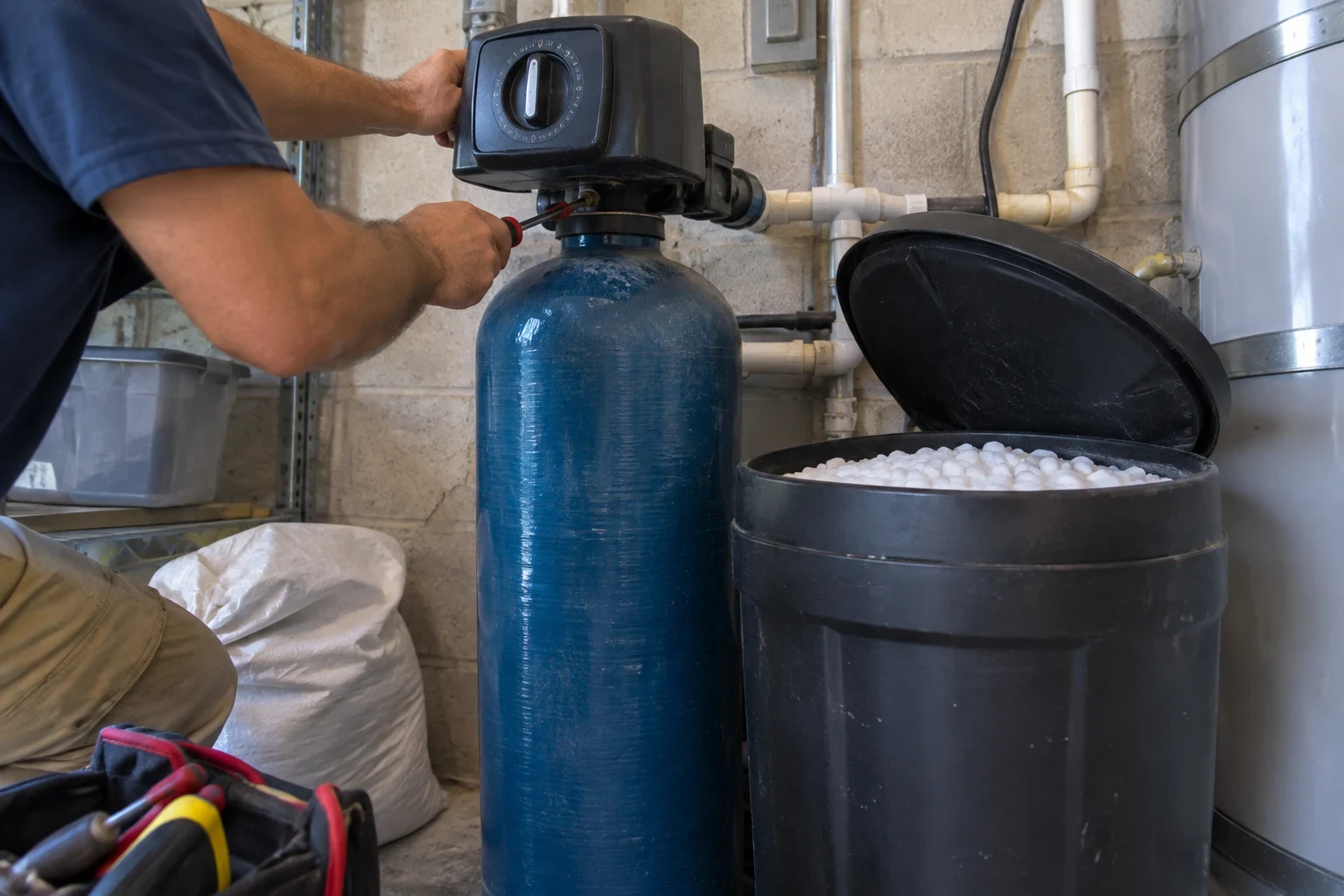
A softener is a simple machine. Hard water runs through a tank of resin beads that hold onto calcium and magnesium. A few times a week the control valve flushes the beads with salty water from the brine tank and sends the minerals down the drain. When any part of that loop stops working, hard water goes straight through to your home.
Most problems come down to a handful of things: a crust of salt blocking the brine tank, a clogged injector or brine line, a valve that lost its settings, or resin that has worn out. Most of these are small fixes. Worn-out resin or a cracked valve body is a bigger call, and we will tell you which one you have before any work starts.
Regular maintenance keeps the small problems small. In a hot, humid garage, salt clumps and bridges faster, so a yearly check is worth it.
What a service visit covers
Brine tank cleanout
Hardened salt gets broken loose, and the mushy sludge on the bottom of the tank comes out. Once the tank is rinsed, we make sure the float and brine well let it refill to the right level.
Injector and brine line
The injector has a pinhole-sized opening that draws brine into the resin tank, and grit plugs it quickly. We take it out, clean it or swap it, then trace the brine line for kinks or spots where air sneaks in.
Control valve check
We confirm the clock is right, the unit regenerates on a sensible schedule and the hardness number matches your water. On older softeners a power blip can scramble the time, so the unit ends up regenerating while you shower. Worn seals and spacers inside the valve get replaced.
Resin bed condition
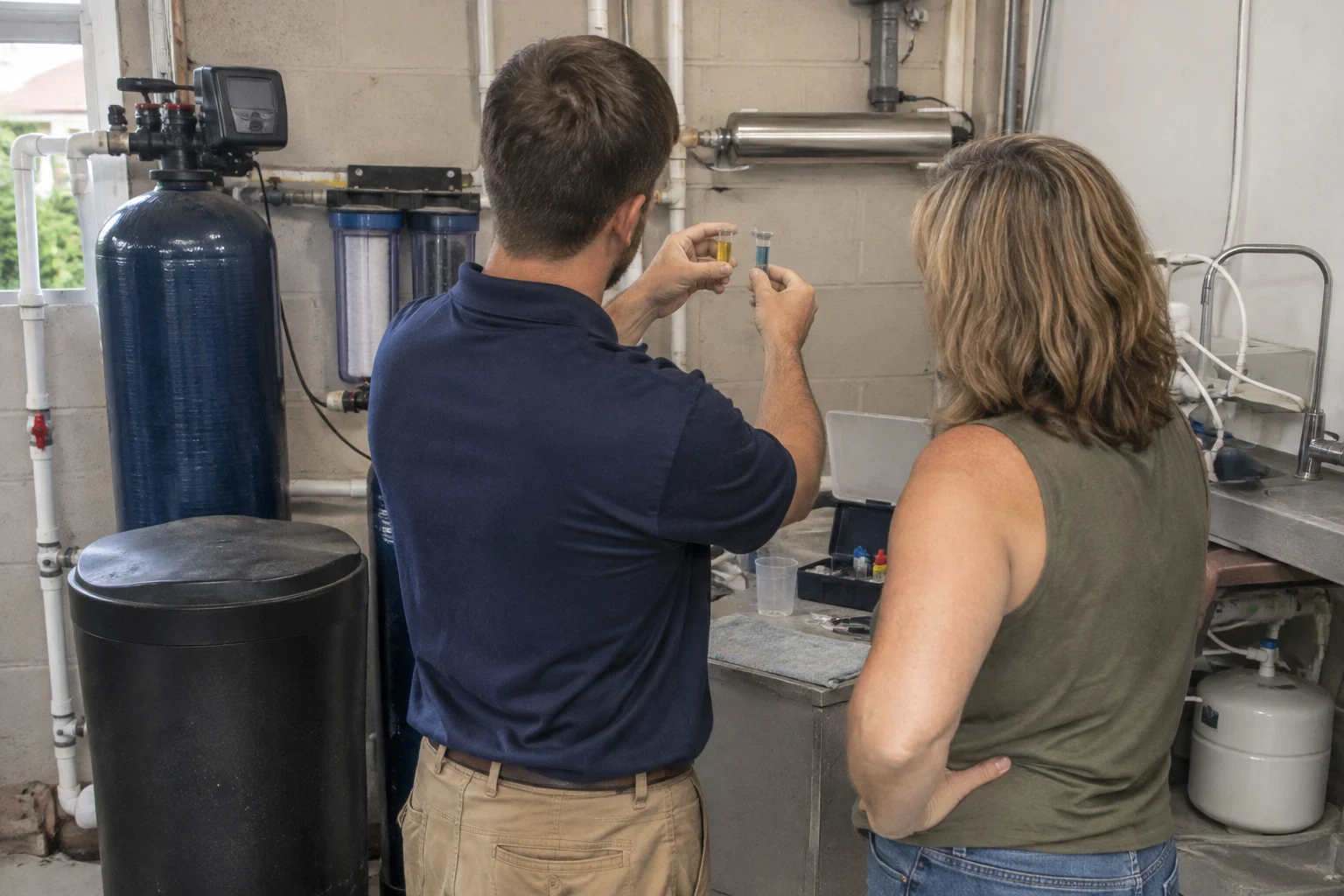
Resin beads wear down with age, and chlorine or chloramine in the water speeds that up. We force a fresh regeneration and see how the unit performs afterward to tell if the resin is still pulling its weight.
Bypass and drain line
If the bypass valve is stuck partway, hard water slips past the softener and you never notice. We make sure it sits in the right position and that the drain line flows freely with a proper air gap.
When your softener is telling you something
- Hard water marks returning
- Cloudy shower glass, spotted dishes and scratchy towels tell you minerals are getting past the unit. It may still click on and run, but it isn't regenerating the way it should.
- Salt that never goes down
- If you haven't needed to add salt in months, the softener has quit drawing brine. A crusted salt layer or a clogged injector is usually the cause.
- Too much water in the brine tank
- A tank that stays mostly full of water usually means a stuck float, a plugged line or trouble in the valve. This one won't clear up on its own.
- Tap water tastes salty
- Either the rinse cycle cut short or brine is leaking through the valve. Seals and settings are the first things we look at.
- Water going to the drain all the time
- A softener that never stops draining burns through both water and salt. Most often a piston seal has worn out or the valve is stuck mid-cycle.
- Weak pressure at every faucet
- Broken-down resin or packed sediment in the tank can squeeze the flow. If pressure picks up once you put the unit in bypass, the softener is the cause.
How a service visit goes
- 1
Start with a phone call
Let us know what the softener is doing, what brand it is if you can find the label, and where it is in your home. With that, we can pack the parts most likely to be needed.
- 2
We diagnose before we fix
We run the unit through a manual regeneration and watch each stage. That shows us where it fails. We show you the problem and explain it in plain words.
- 3
You get a straight answer
We tell you what the fix is and what it costs before we do it. If the unit is old and the repair would cost close to a new one, we say so. Our Water Softener & Filtration System Replacement page covers that route.
- 4
Repair, reset and clean up
We make the repair, set the clock and hardness, and run a full cycle to confirm it works. We wipe up any water and salt and leave the area the way we found it.
What moves the cost of a repair
Most softener repairs come down to one part and the time to fit it, not a whole new system. The price follows what broke and how hard it is to reach. You hear the number before we pick up a tool.
- Which part failed
- Clearing a salt bridge or cleaning an injector is a short job. Swapping a control valve or replacing the resin is a bigger one and costs more.
- Brand and parts availability
- Parts for the common valve brands are easy to find. Older or off-brand units may need special-order parts, which adds cost and some waiting.
- Condition of the resin
- Worn resin will not soften water no matter how good the valve is. If the bed needs replacing, that becomes part of the job.
- How easy the unit is to reach
- When the softener stands in an open garage with room around it, the work goes fast. A unit squeezed into a small closet or behind shelves in a utility room takes more time to get at.
Questions about softener service
- How often does a softener need a maintenance visit?
- Once a year is plenty for a typical unit. That visit covers a brine tank cleanout, a look at the injector and a check of the settings. Between visits, keep the salt topped up and lift the lid every so often to look for a hard crust.
- Can I break up a salt bridge on my own?
- Often, yes. Switch the softener to bypass first, then push a broom handle slowly down through the salt until the hard layer cracks. Be gentle around the tank walls. If the crust comes back or the water level stays high, that is the time to phone us.
- Do you service softeners someone else installed?
- In most cases we do. When you phone, give us the brand and model, or read off the label on the control valve. Some older units use parts that are tough to find, and we will let you know that up front before booking a visit.
- Should I repair an older softener or replace it?
- It comes down to the age of the unit and what actually failed. A clogged injector on an older softener is a cheap, worthwhile fix. A cracked valve plus worn-out resin can add up to nearly the cost of a new system, so we explain both options and you decide.
- Which salt works best in my softener?
- Use the pellet or crystal salt made for softeners. Rock salt carries more dirt, and that grit builds up on the tank floor and clogs the injector faster. Stick with one kind and don't fill the tank all the way to the top.
- What happens if the softener acts up again later?
- We stay available after the job. Our ongoing customer support for maintenance, filter replacements, and service needs means you can phone us when something seems off, and we will work out the next step with you.
Get your softener working again
Tell us what the unit is doing and we will explain what is likely wrong and what it takes to fix it. Your quote comes by phone, before any work starts.